Wednesday, 5 February 2014

AS G3: Audience Research - Results and Responses


We hoped to get a sense of whether our genre would be popular in the public opinion, and we sadly received mixed results. Only 50% of people were interested in psychological horror films. As a result we decided to merge several genres into one, to both integrate multiple stylistic features which we found successful in our test shoot, and also to satisfy as much of the public as possible.

Thankfully we received a far more positive response to whether the public like foreign films, with the greatest percentage saying they were indifferent and a higher percentage of people saying "I like them" than not liking them. This meant we could confidently make the film in a foreign language and not receive a negative response.

This question was largely unsuccessful in retrieving the information we were expecting as the results indicated that a large portion of the public misread the question. Many people answered with English horror films that had been dubbed over, or many replied with ANY horror film spoken in English (something entirely unhelpful to us).

This was interesting for us, as it showed us who the audience expects to be the protagonist in a psychological horror. This meant we were creating a character that was a progressive representation of men as it showed not all males have to be macho and gung-ho to be masculine, our character is scared witless in our opening scene and if this had been made into a feature film we all agree he would use his intellect and quick-thinking to "save the day".


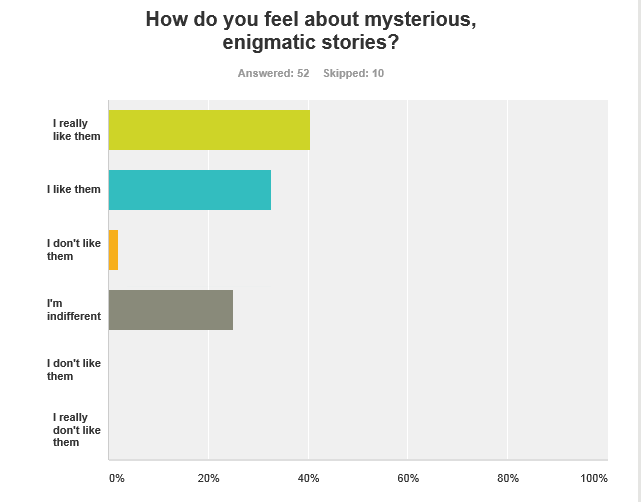
The results showed a remarkably positive reply, with the vast majority of people saying they "really like them" or just "like them" with only 25% saying they did not like them. This was good news to us as we knew that the theme of enigma would be prevalent in our film, so these results were very reassuring.
 
As with the "What horror films have you seen" question, this question received very mixed results. Needless to say we worked through the eventual 63 replies of varying relevance and discovered confusion at every turn, but the majority still proved useful to us. We since decided to change our title to "Overseer", so these results are no longer valid to our title.

Tuesday, 4 February 2014

AS G3: Feedback on shoot - successes and future notes.

Where?

  • Isaac's dad's apartment
  • On the street outside Isaac's dad's apartment

When?

  • Sunday 19th January 2014, from 11 o'clock to 18 o'clock.
  • Sunday 2nd February 2014, from 11.30 to 18.45

How?

We used multiple pieces of camera equipment:

  • Canon 600D DSLR 
  • RODE shotgun microphone 
  • Fig Rig (homemade)
  • Tripod
  • Portable Lighting Rig
    • (2nd of Feb): Tracking Dolly, which was incredibly useful and gave us some fantastic shots
On the second shoot, we spent a good deal of time adding to our character's costume and the feedback we had been given for our first shoot was essential in making these decisions.

The four polaroids used, with Isaac dressed up as the Overseer

  • We added a "5" carved into the left hand of our protagonist
  • Instead of using post-it notes, Isaac came up with the idea of using his polaroid camera, wherein he would hold the numbers dressed as the antagonist

With whom did we go?

  • Production crew
    • Isaac H - Camera operator, Director, Cinematographer
    • Georgia P - Assistant Director, Continuity-control, Shoot Management and lighting
    • Alexander D - Actor

What was successful about the shoot?


  • We discovered that as a team we work very efficiently and effectively together, without deconstructive criticism and an uncanny ability to create a productive, energetic mood
  • The lighting was excellent, despite us running out of daylight early on
  • The entire crew was aware of the importance of mise-en-scene, meaning that everyone was able to contribute to the character's traits and non-verbal language
    • We focused even more on mise-en-scene on the second shoot as we realised it's importance upon reviewing the first shoot's rough cut

Particular shots that were successful


  • We all agree that the shots were very successful in creating character exposition, especially with the even more successful lighting and the addition of track shots
    • On a lesser note, we all agreed that the close-ups were composed excellently, which will hopefully help the positioning our protagonist with audience

What was less successful?


  • Time management was definitely something that affected us greatly, and is something we will have to keep in mind for future productions. 
  • Occasionally, the actor would feel as if he was falling out of character. For future productions, having a 100% clear idea as to how the lead should act out the character will be vital to maintain mise-en-scene. 
  • Continuity was at times off, for example when the actor forgot to wear his glasses or when the curtain in the background would change positions
    • On the second shoot, we accidentally forgot to capture the sound on the first 8 or so shots. To get around this, we will have to record dialogue and add it in later.

How important was the storyboard in the filming process?


  • Relatively. It was good in terms of the chronological filming of the story, but for the planning of the way we wanted to shoot it became less relevant. 
  • For example, the original storyboard showed the actor immediately putting his hands to his head after getting out of the bed. However, when we then began filming, we ended up making the character get out of bed, feel slightly woozy, weakened walk a few metres before collapsing on the floor.
    • Because we had completed the cinematic by the second shoot, we had a much clearer idea as to how we wanted our opening to be like.
    • Additionally, we managed to use the first shoot for our rough cut and could therefore also decide which shots to cut out and which to leave out, so we keep the time contained. (Rough cut will be added soon).

What will we be shooting next and when?


  • The only shot we need next is of the TV displaying the threatening messages, something that Isaac should be able to do before the deadline.
    • The above has been completed, with a slight change. Instead of having just text being displayed, we filmed Isaac holding cards with threatening messages on them, as to add to the conventions of horror and thriller. Thus, we are down to the final edit and the final touching up that needs to be done before deadline.

AS G3: "The Final Shoot...Round 2 [3D]"

On Sunday the 2nd of February the group met for a final shoot at Isaac's Dad's flat. We knew that this was our last chance to make the shoot as perfect as it possibly could be, so with that in mind we set about (not so) speedily making the prosthetic that would replace the sloppy, cartoony "5" written on the wrong hand, and one & a half hours later we began the shoot.

This is a list of improvements we made:
  • We made sure to use a wider variety of shots
  • We included multiple track shots
  • We changed several fig rig shots to tripod shots
  • Georgia had a very keen eye for continuity (constantly forcing us to review footage to make match cuts in the edit)
  • We used a FAR better prosthetic "5" for his hand
  • We used conventional polaroid pictures for the "4","3","2" and "1" which we changed to "Bingo" to give the scene a sense of sick humour
  • We filmed the TV sequence, then filmed a TV showing the TV sequence
  • We essentially invented the character controlling the protagonist from afar, who we showed in polaroids and the TV sequence
  • The invention of this character led to the title being decided: "Overseer"
  •  We used a new, more bland remote
  • We left the house in it's homely state which enhanced character exposition and increased film time by reducing set-preparation time
  • We agreed on a typeface for the signs which seemed savage and exciting which is very conventional of the genre
  • We created a costume for the antagonist which included a plain suit, black tie and scary mask which hides the identity of the villain

Monday, 3 February 2014

Alexander D: Analysis of title opening [The Last of Us]


WHO IS CREDITED?


00:01
Naughty Dog
Production Studio
00:10
Bruce Stradley
Game Director
00:10
Neil Druckmann
Creative Director
00:14
Erick Pangilinan
Art Director
00:17
Michel Hatfield
Lead Technical Artist
00:20
Travis McIntosh
Lead Programmers
00:20
Jason Gregory
Lead Programmers
00:24
Mike Yosh
Lead Gameplay Animator
00:26
Christian Nakata
Lead Environment Artist
00:29
Jacob Minkoff
Lead Designer
00:31
Eben Cook
Lead Visual Effects
00:35
Ryan M James
Lead Editor
00:38
Phil Kovats
Lead Audio
00:41
Michael Knowland
Lead Character Artist
00:43
Vivian Ding
Lead Lighting
00:45
Erin Daly
Lead Multiplayer Designer
                  00:47                 
Shaun Escayg
Lead Cinematic Animator
                  00:47                 
David Lam
Lead Cinematic Animator
00:50
Nate Wells
Lead Artist
00:54
Gustavo Santaolalla
Music
00:57
Ashley Johnson
Starring
00:57
Troy Baker
Starring
00:59
Evan Wells
Co-President
00:59
Christophe Balestra
Co-President

POSITIONING

  • The names in the credits are placed in the blank areas of the screen, shown in the .gif below. This centres player's/audience's attention to the blank background and the text. Additionally, it is easy to read the text  - in HELVETICA font.

ANIMATION


  • Viral infection animation goes on in the background, sticking to the plot of the game (in which a mutated strain of the cordyceps begins to spread and infect the human populace, turning them into infected monsters). This also corresponds with the sound in the background, which is explained further below.
  • The text has an animation as well: fading in from the right, left or middle.

TIMING

  • Because it is a video game, the audience will want to get going with the game as soon as possible, as opposed to patiently waiting to begin the adventure that awaits in the game. As such, the titles are shown for the maximum duration of 3 to 4 seconds, enough time for the audience to see the people responsible for the game, and to keep the player from putting down his controller to make himself(or herself) a cup of tea.


CONTENT

  • The chosen crediteers are those who have been responsible for the design, creative edge and overseer production of the game. Without these people, there wouldn't be a game - which underlines the order in which they are shown. Below are some of the crew mentioned in the title sequence:

    • Production Studio


    • Naughty Dog, who've been responsible for adventure games such as the Crash Bandicoot franchise, and the critically acclaimed Uncharted franchise. They're the overall production company, under which the below people are employed.


    • Directors:
    • The Game Director is shown first. His role is important, as it is his job, just as with a film production, to ensure that the development of the game is successful.
    • Creative Director, is the key person during the game development process, overseeing any high level decisions that affect how the game plays, looks or sounds.
    • The Art Director or Lead Artist works with the Game Designer in the first instance and devises the game’s visual style and directs the production of all visual material throughout the game’s development. The Lead Artist is responsible for the overall look of the game. The Lead Artist is mentioned twice, meaning that the lead artist mentioned later is responsible for a smaller aspect of


    • Artist (Technical)
    • The Technical Artist functions as the link between the artists and the programmers. They ensure that the art assets can easily be integrated into the game without sacrificing either overall artistic vision or exceeding the technical limits of the chosen platform. The Technical Artist works part of the art team and coordinates closely with the Art Director as well as the Lead Programmers.

    • Programmers
    • The lead programmers lead the programming team, which for a large scale production such as this requires the cooperation between two people - which is why they're shown simultaneously.

    • The programming team includes: 
      • Gameplay Animator 
      • Environment Artist 
      • Lead Visual Effects 
      • Character Artist 
      • Lead Lighting
    • Lead Designer
    • The Game Designers are responsible for devising what a game consists of and how it plays. They plan and define all the elements and components of a game: its setting; structure; rules; story flow; characters; the objects, props, vehicles, and devices available to the characters; interface design; and modes of play.

SOUND

  • The style of non-diegetic sound chosen in this title sequence is a sole, somber guitar. This is to put the player into the mood of being on their own or at least somewhat distant from civilisation.
  • A newsreel from multiple news channels and radio broadcasts are played alongside the abovementioned guitar. This also helps establish the fall of society and some of the history behind the viral outbreak. This coincides with the animation in this title sequence.

WHAT CAN WE USE THIS FOR?

  • What we can take from this title sequence is the importance of who is credited. The overall director, be it film or game director, is usually the first person who is credited. However, the production studio is the very first aspect to be shown to the audience, which will catch the attention of die-hard fans of that particular studio - they'll know what to expect from that studio.
  • The positioning of text is very important. If we are to follow the rule of thirds, we will be able to pull off good text positioning.
    • Additionally, any blank spaces left in the shots can be utilised for credits - though we have to be careful not to make the shots look messy or too "full".

ICT note:

For the .gifs above, I downloaded the video from YouTube and stuck it into a video-to-gif software. From there, I was able to take the video and convert it into a gif, and select the frames that I wanted to include. However, in the conversion, some of the quality was lost from the original video, despite running them at the highest conversion rate possible.

Saturday, 1 February 2014

Alexander D: Conventions of Horror and Thriller

It can be said that the horror and thriller genre often overlap with each other. This is an attempt at recognising the overlaps by looking at each of the two genres individually, and then establishing what it is that we are trying to achieve with our film opening.

Following post contains spoilers. You have been warned.

THRILLER

The main characteristics of thriller

  • Suspense, which is the crucial aspect of thriller. The sense of unknowing and mystery helps create an "on-edge" feeling for the audience, making the actions of the protagonist and - possibly - the antagonist unpredictable. This "on-edge" feeling further ensures that the audience is, as the word suggests, constantly alert to the story of the film. As Alfred Hitchcock said himself: “There is no terror in the bang, only in the anticipation of it.”

Themes

The elements of the thriller genre vary, but they contain primary elements that help define the genre. For example:
  • Each character is, either by accident or out of curiosity, dragged into a dangerous conflict or situation that they are not prepared to resolve.
    • Often, the film's main plot line focuses on a mystery that must be solved.
  • The forces of the antagonist's must initially be supreme in terms of intelligence and strength compared to the protagonist's.
    • Furthermore, the protagonist and antagonist may somehow battle each other, either through physical fighting or a battle of the mind or wits.
  • The characters, setting and plot has to be credibly realistic or natural.
    • On a smaller yet significant note, the presence of innocent characters draws a parallel with what is perceived as an essentially corrupt world.
A selection of sub-genres of Thriller are listed below, along with their common themes.


In Crime Thrillers,:

o    Ransoms

o    Captivities

o    Heists

o    Revenge

o    Kidnappings

In Psychological Thrillers:

o    Mind games

o    Psychological themes

o    Stalking

o    confinement/deathtraps


o    obsession


In Mystery Thrillers:

o    investigations
o    "whodunit", or detective storyline, akin to Film Noir

Paranoid thrillers


o    False accusations

o    Paranoia

Characters


The characters present in thriller films are typically "common" people. Following the common conventions of the genre, they must be realistic and help create a sense of verisimilitude. They have more than often a shady side to them that may not initially be present, and appears later in the plot. However, there are characters who can be considered as stock characters.
  • Examples of these characters include:
    • Criminals
    • Stalkers
    • Innocent victims
    • Characters with deep dark pasts
    • Sociopaths
    • Cops, akin to those seen in Film Noir
  • The protagonists are frequently ordinary people, and while the protagonists of thrillers have traditionally been men, women leads are increasingly common. An example of this would be in Silence of the Lambs (Demme, 1991), where the female lead is played by Jodie Foster.
  • Commonly in crime thrillers, the protagonists are "hard men", men who're accustomed to dangerous situations - such as police officers and detectives.
  • In psychological thrillers, the protagonists are reliant on their mental capabilities, whether that is battling wits with the antagonist or battling for sanity in their own mind.

Story

The themes of the assorted sub-genres provide a basis for the story of a thriller. There are, however, conventions that the majority of thriller movies follow:
  • The protagonist is set against a problem. It does not matter which sub-genre a thriller falls into, it will emphasise the danger that the protagonist faces.
  • Another aspect that is emphasised is the puzzle aspect of the plot. The audience is given clues to the solution of the problem or the revelation of the true danger. The threat is sometimes abstract or unseen.

Setting

The setting of thrillers is largely set in the urban and suburban scene. Often, thrillers present the world and society as dark, corrupt and dangerous. The atmosphere of creepy menace and sudden violence is mostly present.
However, thrillers that are psychological thrillers make use of, as with horror, the themes of isolation, a pastiche of feelings or personality disorders in the characters. An example of this would be the film classic Psycho (Hitchcock, 1960), where the character Norman Bates has a mental disorder in which he assumes the identity of his mother and himself.

HORROR

The main characteristics of horror

  • The primary focus of any horror film is to play with the fundamental fears of the audience, be it home-invasion,  a murderer or a phobia. It is this that is essential in a horror film.
  • Additionally, creating an intense atmosphere is key to establishing the sensation of horror in the audience.

Themes and conventions

As with thriller, the themes  within a horror film vary in themes from genre to genre. Detailed examples of themes below:


  • Ghosts, demons, or other depictions of supernatural occurrences. 
  • Often, Supernatural-Horror films combine elements of religion into the plot. 
  • Common themes in Supernatural-Horror films include the afterlife, the devil, and demonic possession. Unlike Religious Thrillers, Supernatural-Horror films are not limited to specific religious elements and can contain more vivid and gruesome violence.

  • In a zombie horror, the protagonist is either placed in the beginning or in the midst of a zombie apocalypse, using everyday tools such as crowbars, sharp or blunt objects to defend themselves - unless it's America, in which most survivors use firearms.
  • In early zombie films, such as Dawn of the Dead (Romero, 1978), zombie films were often metaphors for the growing consumerism in capitalist America, the zombies resembling this metaphor. In modern terms, the idea is more weighed upon the thoughts of viral outbreaks, such as H1N1 and STD's. While up to debate as to what type the zombies/infected of 28 Days Later are, the concept of the film falls under the latter category.

  • In teen slasher horror, the themes are largely centred upon the vices of teenagers, playing on the themes of promiscuity, sex and the transition into adulthood.

  • In a psychological horror, it is a play on the mind, for either the protagonist, the audience or both. The protagonist faces a situation whereupon an aspect of their mind or psyche is threatened by inner or outside forces.


Characters


Protagonists are often civilians, and in most cases female (e.g. Ellen Ripley(Sigourney Weaver) in Alien, Lorraine Warren(Vera Farmiga) in The Conjuring). They are thrown into a situation that is fundamentally horrifying, and through perseverance and survive the ordeal - though not before losing a large proportion of friends or family to what is hunting them, who is murdering them or, in some cases, before they have murdered everyone themselves.
  • The concept of "The Final Girl": This particular type of character is most evident in the sub-genre of horror known as teen-horror. The Final Girl is at first seen as weak and fragile, but in the end proves to be the strongest of the group of teenagers. They are usually portrayed as being morally clean, abstaining from drugs and alcohol and don't involve in sexual acts.
  • An example of the protagonist falling directly into a horrific scenario would be from the opening scene of George A. Romero's Dawn of the Dead remake from 2004. (Video below).   
  • Interestingly enough, the male characters that have some level of bravado present in horror films are usually what gets them killed, especially in teen horror. There are few exceptions, though, such as Predator (McTierman, 1982), The Thing (Carpenter, 1982) and the original Night of the Living Dead (Romero, 1968), where the lead was (controversially, at that time) an afro-american. There aren't many protagonists in horror films that are males, the some of whom are portrayed in comical horror films(e.g. Shaun of the Dead (Wright, 2004) and Army of Darkness (Raimi, 1992).

Story

The sub-genre of horror is very influential as to how the plot develops.
  • A supernatural or monster horror set in the wilderness will set the character against the threat of isolation and being the prey - a monster in the woods, being the central antagonist.
  • In modern zombie horrors, it is often the interaction between the living survivors that drive the plot, less than the violent interaction between the living and the living dead.
  • A psychological horror, as discussed under themes, will focus on a plot wherein the protagonist is somehow attacked psychologically, either upon his mental state of mind or his identity. 

Setting


Once again, the genre determines the kind of location that will be used in a horror film.
  • Urban settings are used to connote the idea of either isolation within the self or claustrophobia, being somehow contained within one place. 
    • Therefore, in these settings, locations are chosen to instil the above phobia. Dark alleyways, abandoned shopping centres or abandoned streets are conventional within urban horrors, especially in zombie horror.
  • In contrast to the above, some sub-genres of horror include locations that are set in the wilderness or somewhere far from advanced civilisation, such as a small lakeside town, to create a sensation of loneliness or isolation.
    • In Science Fiction horror, the setting is set in space to establish the same sensation of isolation and of being alone. An example of this would be Alien (Scott, 1979), where the horror that the ship's crew face is all set on the ship.
  • The settings in psychological horror are often deceptively ordinary, such as cheerful suburban homes or shabby hotels. Especially the former is something we have available, and something that we can use to establish the setting.

What we are trying to achieve:

What we are essentially trying to achieve in our opening is the establishment of elements from both the horror and thriller genres in our film opening. Therefore, the type of opening we want to establish is somewhat akin to the Dawn of the Dead example further above (without, of course, the zombies), whilst also building up the suspense that thriller contains. As such, the type of horror opening we are going for is down to the very specific sub-genre of horror-of-personality. Our character has no recollection of his own identity (which we will attempt to establish through mise-en-scene, camera and potentially sound) and will be thrown into this mind-twisting plot from the get-go. Thusly, it is important that we are able to establish the fact that our opening is a combination of thriller and horror, and not just the one or the other. 

As such, we must draw upon the themes, setting and character type from the two genres to address our concept, and combine them, so it fits our plot and opening sequence. Finally, whilst not mentioned within this post, the combination of these two genres must also be present in our chosen typography. It is absolutely key that we include these conventions, as to not stray from our chosen genre.